

How Website Speed Impacts E-commerce Conversions

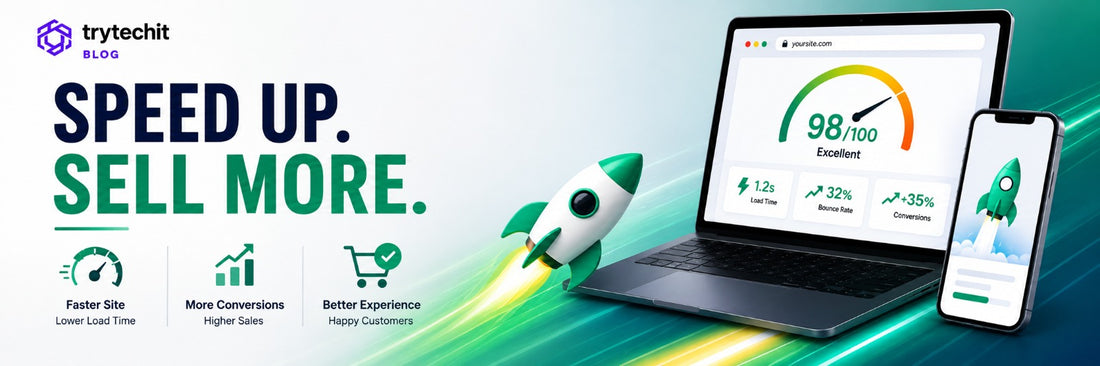
Website speed is not just a technical factor; it has become a critical business metric in e-commerce today. Speed matters a lot because when your website runs slowly and takes more loading time than expected, it frustrates the user. It has a direct impact on revenue, customer experience, and search rankings.
According to Google and leading CRO studies, even a 1-second loading delay can consistently reduce the conversion rate by up to 7%. It means that if your e-commerce store is slow, it is a major reason your sales are decreasing day by day.
In this blog, we will discuss how a website’s speed affects the conversion rate of e-commerce, and it should be a top priority of online businesses to optimize their website’s performance rate.
What Is Website Speed in E-commerce?
Website speed is crucial in e-commerce. What is it exactly?
It’s how quickly your web pages load and users interact with them. It includes some key metrics, such as:
- Page load time
- Time to first byte (TTFB)
- Largest Contentful Paint (LCP)
- First Input Delay (FID)
Google groups put all of these under Core Web Vitals, which are some of the key indicators in user performance and experience.
The Direct Impact of Speed on Conversions
Every Second Costs Revenue
It’s true, every second does cost revenue. The most widely cited findings in e-commerce tell how speed changes affect conversion rates at large:
- Even a 1-second delay can reduce the conversion rates by 7-20%.
- Sites that run fast usually convert better than the slower sites.
It’s not just about findings; even industry giants have proven it:
- Amazon tells how it lost 1% in sales for every 100ms delay.
- Walmart observed an increase in conversions after improving the page speed.
So, it’s not just about performance; it’s about profit, too.
Impact on User Experience (UX)
First Impressions Matter
The moment users come to your website, they expect immediate communication. If loading stays for too long, they leave and switch to alternatives (in numerous instances).
- About 40% of users leave sites when it takes more than 3 seconds to load.
- About 53% of mobile users abandon a site if it takes longer than 3 seconds to load.
A slow website often leaves the user frustrated. A fast-loading website establishes trust and confidence among users in your brand.
Smooth Experience Leads to Higher Engagement
Here’s what fast-loading websites do:
- Keep users engaged for a long time
- Improves the user’s navigation experience
- Increase users' product exploration
On the other hand, slow websites result in poor user engagement and higher bounce rates.
Also read: How to Improve Conversion Rate for an E-commerce Website
Website Speed and Bounce Rate
Bounce rate is the percentage of users who leave your website without any interaction.
Speed Directly Increases Bounce
- When your webpage increases its load time from 1 to 3%, the bounce rate increases by 32%
- While the same if it goes to 5 seconds, bounce rates can increase by 90%
Now you understand why websites lose trustworthy customers before they even see your products.
Now you understand why websites lose trustworthy customers before they even see your products.
Impact on Mobile Commerce
As discussed, mobile devices dominate most of the e-commerce landscape, specifically in regions such as India and Asia-Pacific.
Less Patience
- Mobile users expects fast loading, at instant clicks
- Poor network conditions increases the speed issues
Studies show that most of the mobile abandonments are high in number because of slow performance.
Why Mobile Speed Matters
- Small screens need fast rendering
- Slow internet connections lead to delays
- Users more easily switch to sites and apps
This is the reason why mobile speed is a necessity and not an option.
Also read: Best Checkout Apps for Shopify
Website Speed and SEO Rankings
Google's algorithm works on website speed, and it’s a proven ranking factor.
If we talk about the web vitals and ranking of Google metrics, such as Largest Contentful Paint (LCP), First Input Delay (FID), and Cumulative Layout Shift (CLS), they play a crucial part.
Websites that meet all of them rank higher in the Google search results.
Faster Sites Get More Traffic
Websites that pass all the core web vitals receive about 70% of the organic traffic, because better rankings lead to more traffic, which leads to more conversions.
Psychological Impact on Buyers
The speed of the website significantly influences consumer psychology. Speed builds trust because it
- Look professional
- Appear more reliable
- Grows confidence in transactions
While slow websites:
- Create doubt among buyers
- Decrease trust
- Increase hesitation when it comes to relying
If we talk about CRO insights, users usually associate the speed with credibility, and that’s what impacts the purchase decisions.
Impact on Revenue and ROI
If you want to improve your revenue gains, the next thing you need to do is improve the website’s speed.
This is what real business impact looks like:
- Faster websites increase revenue without increasing unnecessary traffic.
- A 2-second site can significantly increase a 4-second site.
For example:
There’s a business with 100,000 visitors every month; it increases your revenue by 14% by just improving the speed of your website.
This is one of the highest ROI activities in e-commerce.
Also read: Web vs. Mobile App for E-commerce: Which Is Better?
Causes of Slow E-commerce Websites
There are many reasons why your e-commerce website suffers from speed issues:
- Heavy images, videos, and unoptimized banners slow your website and increase load time.
- Too many apps and scripts, along with excessive plugins, increase page weight, making the page slow.
- Poor hosting, using cheap, overloaded servers, makes response times slow.
- Unnecessary features and bloated themes affect the performance of your website in a negative way.
- Poor mobile optimization, especially desktop-first designs, usually behaves poorly on mobile devices.
Common Mistakes to Avoid
1. Never ignore mobile speed, because most of the users shop on mobile; do not optimize only for desktop.
2. Do not add any overloading features on your e-commerce website, because many times, too many animations and plugins slow down the performance of the site.
3. Always test the real user experience; most of the time, it’s tested on fast internet and not in real-world conditions.
4. Do not focus only on the design; just a visually appealing website will not bring a conversion rate.
Conclusion
Website’s speed is another crucial factor in e-commerce conversions. From user experience and SEO rankings to customer trust and revenue, speed plays an important role in every stage of the user journey. Fast websites convert more, while slower ones make you lose customers, and even small improvements directly impact revenue at large in the e-commerce landscape.


