

Web vs. Mobile App for E-commerce: Which Is Better?
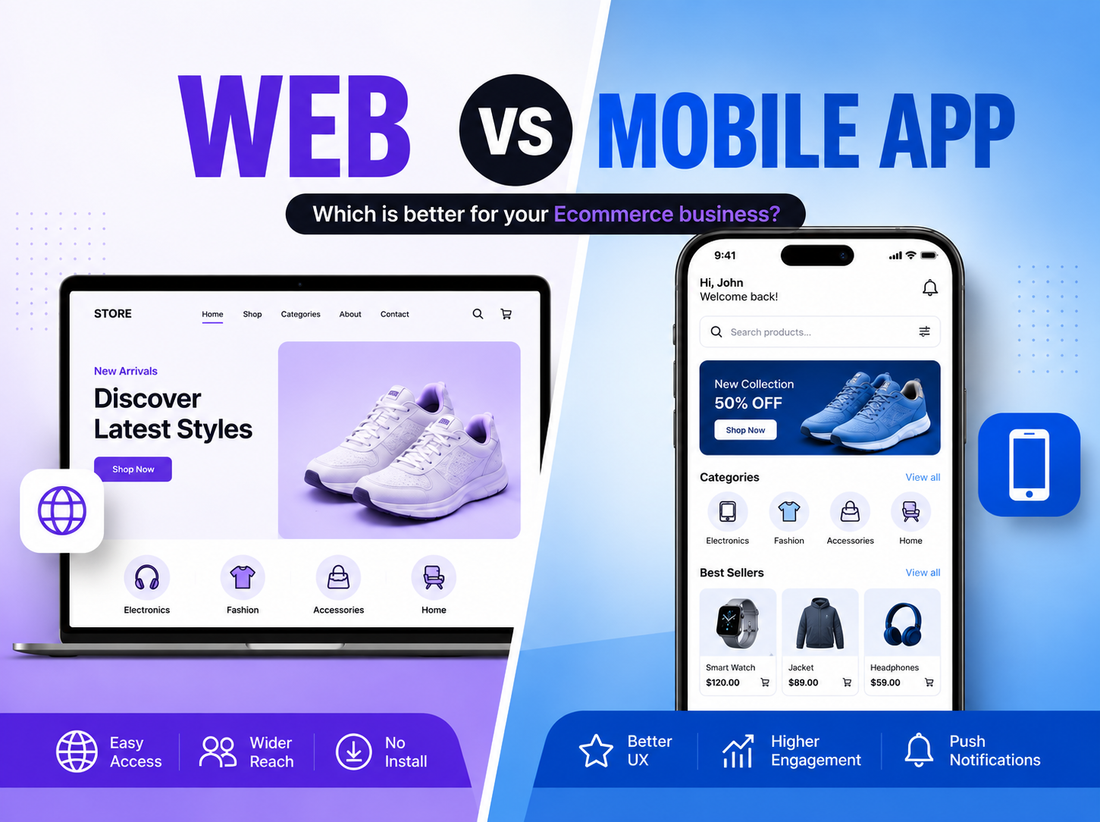
It’s complex to choose between an e-commerce website and a mobile app in a time where about 70% of global e-commerce sales are contributed by mobile commerce. In this condition, making a critical decision for any online business becomes important. Businesses have to carefully assess which platform provides the best results for their services.
In this blog, we will discuss both options in depth, with critical comparisons, advantages, and disadvantages, and some of the best use cases to help you make the right choice.
Understanding E-commerce Websites
Talking about e-commerce websites, it’s a kind of digital storefront that’s accessible on desktops, tablets, or smartphones via web browsers. It hosts the product, catalogs, facilitates transactions, and acts as a central hub for customer interactions. It’s a crucial foundation for an online business.
Most of today’s e-commerce websites usually try to optimize for mobile devices and guarantee a responsive design across all the devices and platforms.
Advantages of E-commerce Websites
1. Wide Reach and Accessibility
Your website can be accessed on any device using a browser, no matter what the operating system is; it ensures a maximum reach and accessibility to your audience.
2. SEO
Search engines help in indexing the websites, and customers find your business organically using Google searches; it’s something a mobile app can’t do.
3. Cost-Effective
When it comes to cost-cutting, building and maintaining a website is way cheaper than the development of separate apps for iOS and Android.
4. Easy Maintenance
Updates do not require user downloads and can be made instantly while reflecting across all of your devices.
5. No Installation Required
No prior app installation is required; users can directly access the products on your store. It lessens the friction in the customer journey.
Also read: How to Improve Conversion Rate for an E-commerce Website
Disadvantages of E-commerce Websites
1. Internet Dependency
Websites need an active internet connection to function effectively; while in offline scenarios, it limits usability.
2. Limited Device Integration
They cannot fully utilize devices such as GPS, cameras, and push notifications. It comes with a limited device integration.
3. Lower Engagement
When it comes to retention, websites often struggle to keep users sticking for a long time. It lacks personalization and push notifications as compared to apps.
4. Slower Performance
Performance is totally based on the browser and network speed in function. It leads to slower load times when a user arrives, making them leave quickly.
Understanding Mobile E-commerce Apps
Talking about mobile e-commerce apps, they are downloadable. They are designed especially for tablets & smartphones and via app stores. It gives a more personalized and interactive shopping experience to the users.
Advantages of Mobile Apps
Superior User Experience
Apps speed up navigation with smooth interfaces and better designs specifically made for mobile devices.
Offline Functionality
Apps provide limited functions even without any internet access, while a website runs entirely on the internet.
Push Notifications
Sending personalized notifications is such a minute thing but makes a large difference. It helps you boost engagement and repeat purchases with your customer.
Better Personalization
When it comes to behavior and preferences, the app stores the data, provides recommendations, and speeds up the checkout.
Higher Conversion Rates
One of the major reasons for increasing conversion rates is that users prefer spending time on apps as compared to mobile browsers.
Advantages of Mobile Apps
Access to Device Features
Apps provide users with more leverage, such as GPS, biometrics, cameras, and others, for enhanced functionality.
Strong Brand Presence
When you install the app on a user’s device, it keeps your brand frequently visible and easily accessible.
Faster Performance
Native apps perform better than most of the websites, as they have an optimized architecture.
E-commerce Website vs Mobile App: Detailed Comparison
Accessibility and Reach
With e-commerce, users get instant accessibility to your products through any web browser. Without downloading anything, they can visit your store. This helps businesses reach a wider audience across multiple devices and makes it highly convenient for them for the first-time process.
A mobile app requires the user to install it from the app store. Once the user installs the app, it adds an extra step, and the apps start attracting more loyal and returning customers.
Cost and Development
Cost is another crucial factor between the two. E-commerce websites are way more affordable than mobile apps, as they only require a single build that works on all platforms.
Mobile applications require separate development for iOS and Android, along with multiple updates and ongoing maintenance. This is what makes an app a large investment for startups and small businesses.
User Experience and Performance
Mobile apps give a superior user experience to e-commerce websites. They are designed especially for smartphones and do not have long loading times, provide smooth navigation, and have an intuitive interface.
They store data and help in personalized recommendations with quick checkouts. On the other hand, e-commerce websites make use of a responsive design to adapt to the mobile screens; sometimes they lag behind apps when it comes to speed and performance.
Customer Engagement and Retention
Mobile apps excel in engagement. Features of push notifications: businesses can send personalized messages, offers, and reminders of repeat purchases.
E-commerce does not have any direct communication channels; they rely on marketing campaigns, emails, and ads for retaining customers, which are sometimes ineffective.
SEO
E-commerce websites have an edge over mobile apps in search engine optimization (SEO). Search engines index e-commerce websites through Google and others. And aids businesses in attracting organic traffic and new customers over time. Discovering mobile apps is not an effortless task; it decreases the effectiveness of customer acquisition and focuses more on engagement.
Device Integration
Coming up to mobile apps, they use features like GPS, cameras, and biometric authentication. This makes it easier for users to access advanced functions such as barcode scanning, location-based offers, and one-tap payments securely. E-commerce websites do not have access to many of these features.
Which One To Choose?
It all depends on your business goals:
Choose a website if:
- Starting a new e-commerce business
- Have to maximize the reach and SEO traffic
- Have a limited budget
Choose a mobile app if:
- Have an established customer base
- Want high engagement and repeat purchases
- Business relies on personalization
Typically, businesses begin with a website and invest in it once they establish their presence in the market.
Hybrid Approach Works Best
A hybrid approach always works best; when you combine both a website and mobile app, it becomes the most effective solution.
Benefits of Hybrid Approach:
- Website attracts new users through SEO
- App retains customers through engagement
- Increases reach and conversion together
Progressive web apps (PWA) are also rising as a middle ground for the two. It offers an app-like experience within browsers.
Common Mistakes to Avoid
1. Never ignore mobile optimization; even if you’re choosing a website, it should be mobile-friendly.
2. Do not build an app too early; when you don’t have sufficient users, it can waste your resources.
3. Never leave loose ends for poor user experience; it may cause slow loading times. Complicated navigation pushes users away.
4. Always keep your website and app synced, or they will lack integration.
5. Do not overlook SEO, even in an app, while a website plays an important role in bringing organic traffic.
Conclusion
There's not always a one-size-fits-all answer to the debate of Web vs. Mobile App. Mobile apps provide more engagement and personalization to the users, while websites help in reach and provide affordability to the users.
So, the perfect strategy for most of the businesses is to start with a strong e-commerce website and use a mobile app in scaling as the brand grows market demand. This is a balanced approach that ensures customer retention and brand visibility, the two ingredients for the success of e-commerce.


